The Attempted Kidnapping of Allie
Dark Lies the IslandThe Attempted Kidnapping of Allie is a failed child-abduction attempt by Ernestine and Kit, two women who exploit a family’s distraction at a castle and then recast their brief contact with Allie as help for a distressed child. The attempt is aborted when Allie’s brother draws attention to her whereabouts, but the women evade immediate pursuit and drive across the border into Northern Ireland. The episode turns on a sharp reversal: a near-separation becomes, in the family’s eyes, an occasion for gratitude, while the apparent rescuers leave before that explanation can be questioned.
Opportunity at the Castle
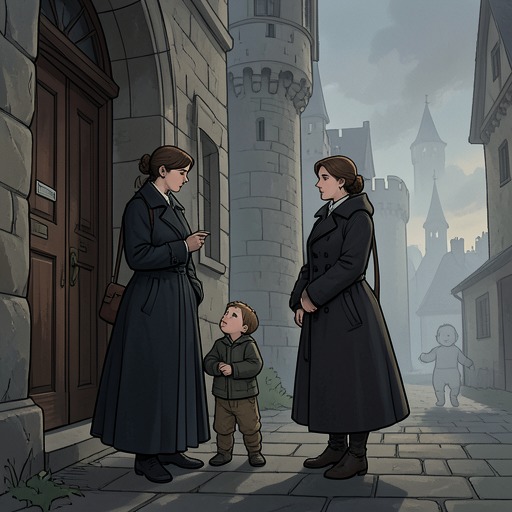
Ernestine and Kit wait at a distance for a family to finish their visit, hoping to approach at a moment when the parents are not about to leave. Their patience is rewarded when the family goes into the castle rather than toward the car park. The women follow among the visitors, moving through the interior past chain mail, coats of arms, and dark stone walls. In this crowded, twisting space, Allie repeatedly wanders away from her parents; even a half-minute of inattention can leave a child out of sight.
The family’s attention divides further as the afternoon crowd moves through the castle. The father shouts at his son, who is absorbed in a handheld video game rather than the historic surroundings. The mother rebukes the father, and the parents argue while their backs are turned. Kit watches the crowd for the cover its movement might provide; Ernestine keeps her attention on Allie. The scene’s opportunity is not simply that the child is distant, but that family conflict and the crowd briefly combine to make her absence seem ordinary.
The Interrupted Attempt
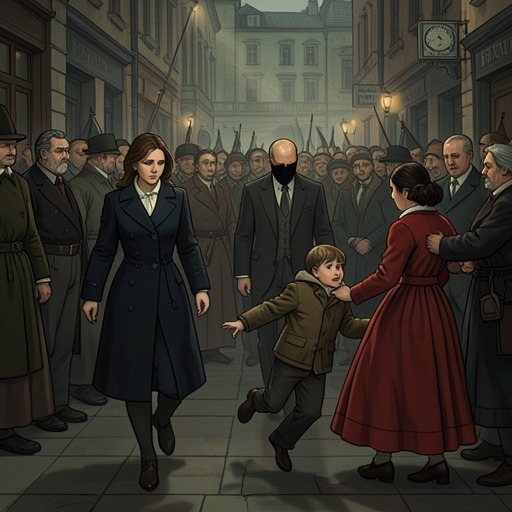
At the chosen moment, Allie is about twenty feet from her parents. Ernestine smiles at her and offers wine gums, while the parents remain occupied with their argument and the boy with his game. The women move from watching to action: Kit takes Allie into an embrace, and Ernestine urges Kit to go. For an instant, the plan appears to be working. But Allie’s brother notices where she is and calls attention to her; the family turns and sees Allie in the arms of a woman with a tight perm.
That interruption changes the meaning of the women’s actions in the family’s eyes. Rather than flee at once, Ernestine and Kit present themselves as having found and comforted a child who had become upset. The adults accept this account: in a chorus of reassurance, the incident is smoothed over, and they thank the women for helping Allie. Allie remains weeping, but the family stays together. The attempted abduction has failed, yet the women leave without being openly challenged.
Escape and Aftermath
Ernestine and Kit turn toward the car park as soon as they have parted from the family. They reach their Toyota just in time: Allie’s father appears in the rearview mirror’s line of sight as the car pulls away. He is too late to stop them, and even a recorded registration would not identify the vehicle, since the plates are false and had been fitted that morning in a garage attached to a bungalow.
The women drive far above the speed limit through Sligo, Leitrim, and Cavan. Their route takes them toward Northern Ireland, then a separate jurisdiction, a contingency built into their plans for failure as well as success. They do not permit themselves to speak again until they have crossed the bridge at the border, where Blacklion gives way to Belcoo. Only then does Ernestine remark on how high her blood pressure must be; Kit responds by scolding her. Their exchange registers the strain of the escape without changing its outcome: they have left the family behind and crossed into another jurisdiction.
Significance
The episode is structured around misrecognition. The parents’ distraction first makes Allie vulnerable; after the attempt is interrupted, the same family’s readiness to accept an explanation lets Ernestine and Kit pass as helpers. The brother’s notice prevents the women from leaving with Allie, but it does not expose their intention. The family’s gratitude therefore becomes part of the escape, converting the attempted abduction into a brief, apparently resolved incident.
The castle’s crowded interior and the border crossing frame two different kinds of cover. Inside, visitors and shifting attention conceal the women’s approach; on the road, false plates and a change of jurisdiction help them evade consequences. The attempt fails in its immediate objective, but the women’s prepared escape route allows them to leave without arrest or identification in the scene. The episode’s uneasy reversal lies in the gap between what the family believes happened and what Ernestine and Kit intended.